Hyperledger Fabric blockchain networks
Hyperledger Fabric allows organizations to collaborate in the formation of blockchain networks. This topic will describe, at a conceptual level, how these networks are structured. If you’re an architect, administrator or developer, you can use this topic to get a solid understanding of the major components in a Hyperledger Fabric blocklchain network. It will use a simple worked example that introduces all of the major components in a blockchain network. You can then read more detailed information in the relevant topic.
A blockchain network
A blockchain network is a technical infrastructure that provides ledger and chaincode (smart contract) services to application consumers. The users of those applications might be end users or administrators.
In most cases, multiple organizations come together as a consortium to form the network and their permissions are determined by a set of policies that are agreed by the the consortium when the network is originally configured. Moreover, network policies can change over time subject to the agreement of the organizations in the consortium.
The sample network
Organizations R1, R2, R3 and R4 have decided to jointly invest in a Hyperledger Fabric blockchain network. They have decided that the network will be administered by R4, who will be responsible for creating network policies that allow R1, R2 and R3 to interact in a manner they deem appropriate. Specifically, R4 will not transact in the network – it only provides administrative functionality to help R1, R2, R3 achieve their collective goals. Many other configurations are possible but this simple configuration is an excellent start to provide a solid conceptual understanding.
Before we start, let’s show you what we’re aiming at! Here’s the final state of the network.
 Caption
Don’t worry that this might look complicated! As we go through this topic, we will build up the network piece by piece, so that you see how R1, R2, R3 and R4 contribute infrastructure to the network to help form it, and agree policies which determine how that infrastructure behaves. Most importantly, you’ll discover how applications consume the ledger and chaincode services provided by the organizations that form the network.
Creating the Network
Let’s start at the beginning by creating the network.
 Caption
We can see that the first thing that defines a network is O1, an ordering service. It’s helpful to think of the ordering service as the initial administration point for the network. As agreed by R1-R4, O1 is initially configured and started by an administrator in organization R4, and hosted in R4. The configuration NC1 contains the policies that govern the administrative capabilities available to R1, R2, R3 and R4, and initially this is set to give R4 rights over the network. This will change, as we’ll see later.
In its simplest form, the ordering service is a single node in the network, and that’s waht you can see in the example. Ordering services are usually multi-node, and can be configured to have different nodes in different organizations. Indeed, the ordering service nodes are in fact a mini-blockchain, whose ledger contains the history of updates to the network configuration, starting with this first configuration, the so called genesis block. This is interesting detail, but for now just think of the ordering service as an administration point.
We can also see a certificate authority, CA4. Certificate authorities play a key role in Hyperledger Fabric, because they dispense identity information that identifies users and network components as belonging to a particular organization. The network configuration NC1 uses these identities to grant different rights over network resources to different organizations, using an MSP. We don’t show MSPs on these diagrams, as they would just clutter them up, but they are important.
Why does the network have this basic structure? Well, it has all the minimal set of components. There’s a set of users – as defined by a CA, a resource – the network, and a set of rights those users have over the network. And all this is made real by the ordering service – in our case a single node running as an operating system process.
Defining a Consortium
Although the network has been started by R4, the network as it stands has very few possibilities. The first thing we need to do is define a consortium. This word literally means “a group with a shared destiny”, so it’s an appropriate choice for a set of organizations in a blockchain network.
 Caption
NC1 is initially configured to only allow R4 create new consortia. This diagram shows the addition of a new consortium, X1, which defines two organizations R1 and R2 as its members. We can also see that two CAs – CA1 and CA2 – are used to identify users from these organizations. R4 can now update the policy definition in NC1 to allow R1 and R2 to create new consortia too. In this way, even though R4 is running the ordering service, R1, R2 and R4 have shared administrative rights over who can define new consortia.
Why are consortia important? We can see that a consortium defines two or more organizations on the network who share a need to transact with one another – in this case R1 and R2. It really makes sense to group organizations together if they have a common goal, and that’s exactly what’s happening in this instance.
The network, although started by a single organization is now controlled by a much larger set of organizations. We could have started it this way, with R1, R2 and R4 having shared control, but this build up makes it easier to understand.
We’re now going to use X1 to create a really important part of a Hyperledger Fabric blockchain – a channel.
Creating a channel for a consortium
So let’s create this key part of the blockchain network – a channel. A channel is a primary communications mechanism by which the members of a consortia can communicate with each other. There can be multiple channels in a network, but for now, we’ll start with one.
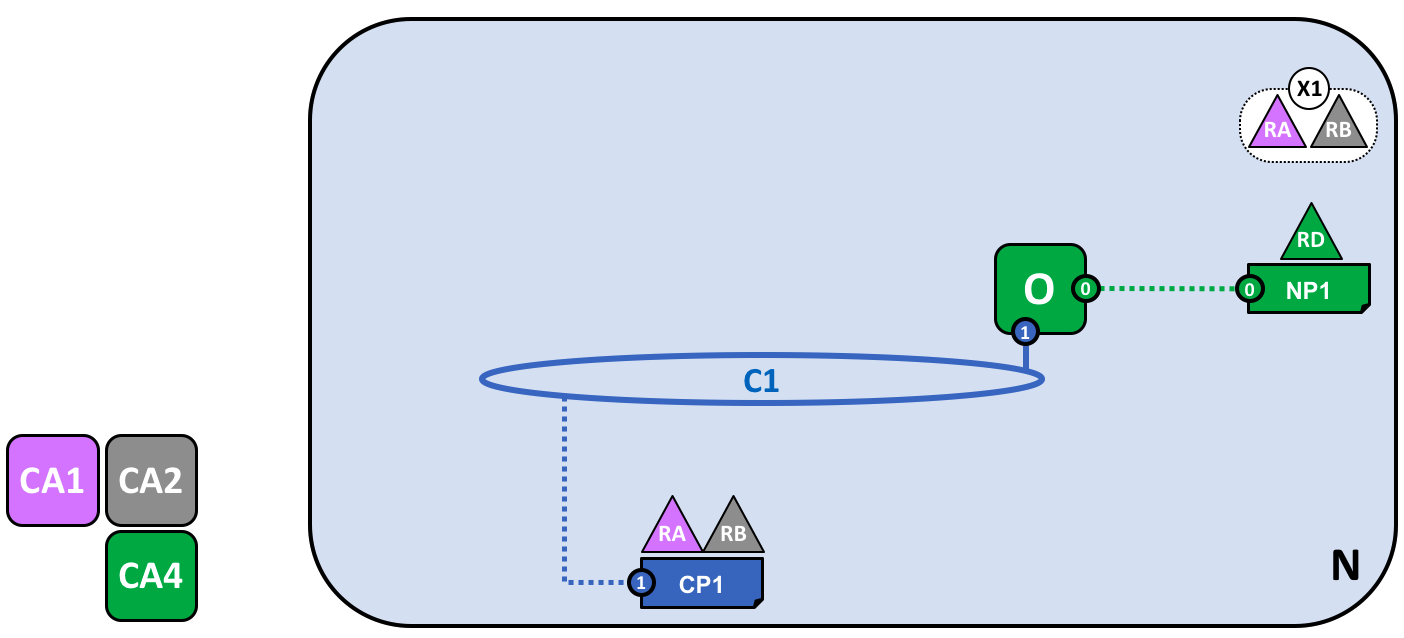 Caption
In the previous step, we saw how R4 could grant R1, R2 the permission to create new consortia. It’s helpful to mention that R4 also allowed R1 and R2 to create channels! So in this diagram, we’ve seen how organization R1 created a channel C1, for consortia X1. That’s what we can see in the network – a private communications mechanism for the consortia X1 that is quite separate to the network N. Organizations R3 and R4 are not in this channel – it is for transaction processing between R1 and R2.
Moreover, C1 has a completely separate configuration, CC1, to the network configuration NC1. CC1 contains the policies that govern the permissions that R1 and R2 have over the channel C1 – and as we’ve seen, R3 and R4 have no permissions in this channel.
Why are channels so important? We can see that once a channel has been created, it is in a very real sense “free from the network”. It is only organizations that are explicitly specified a channel configuration that have any control over it, from this time forward into the future. Channels are therefore are useful because they allow for data isolation and privacy of communications.
We can see that channel C1 is initially created at the ordering service O1, but has nothing attached to it. We’re going to connect the ordering service to other components soon, but at this point, a channel represents a potential for connectivity. We’re going to connect client applications and other network components together on a channel, but for now, none of this has been done.
Peers and Ledgers
Let’s now start to use the channel to connect blockchain components together. We can see that our network N has just acquired two new components, namely a peer node P1 and a ledger instance, L1.
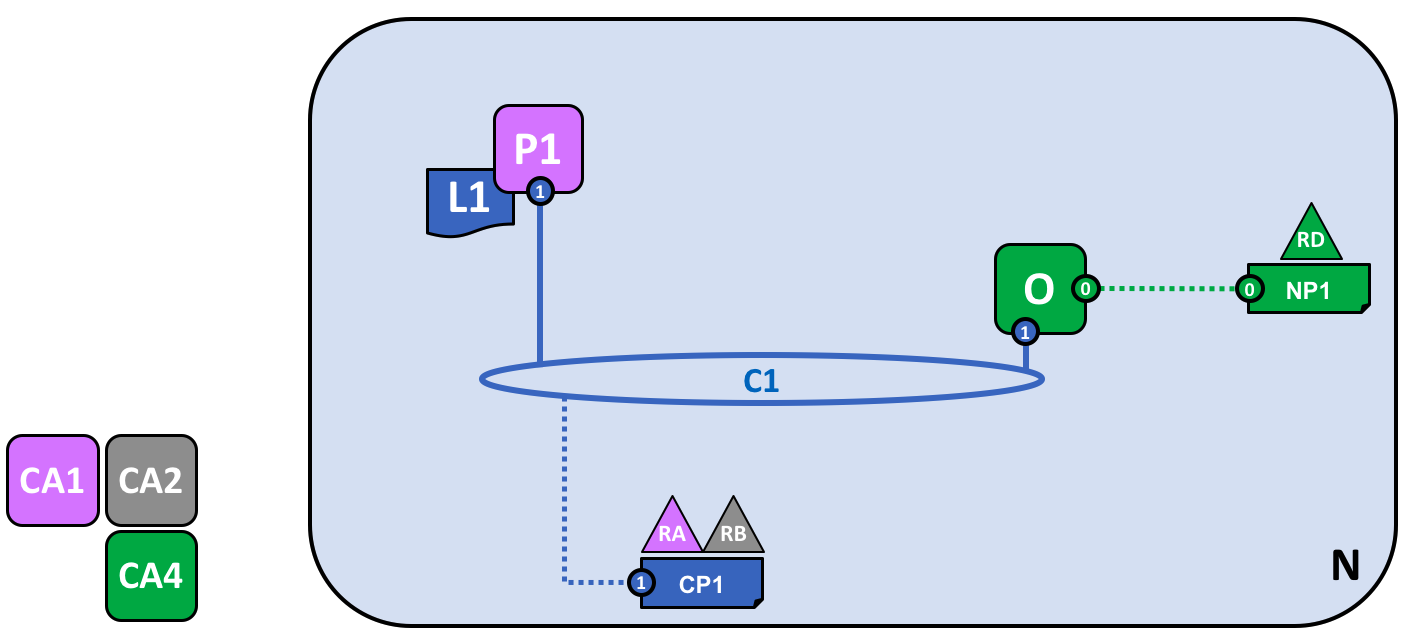 Caption
Peer nodes are the network components where copies of the blockchain ledger are hosted! At last, we’re starting to see some recognizable blockchain components!
An administrator in R1 has configured the peer node P1 and started it. A key part of a peer’s configuration is an identity issued by CA1 which associates P1 with organization R1. After P1 is started for the first time, an administrator can ask P1 to join channel C1 on the order O1. When the orderer receives this request, it uses the channel configuration CC1 to identify P1’s organization – R1 – which determines the peer’s permissions on this channel. From this stage, we can say that P1 is joined to channel C1.
P1’s purpose in the network is purely to host a copy of the ledger L1 for others to access. We can think of L1 as being physically hosted on P1, but logically hosted on the channel C1. We’ll see this idea more clearly when we add more peers to the channel.
We can see organization R1 has added a resource to the network in the form of peer node P1. The initial network was formed from resources from R4 – an ordering service – and has now been extended by organization R1, albeit it in a private channel.
Applications and Smart Contracts
Now that the channel C1 has a ledger on it, we can start connecting applications to consume some of the services provided by the ledger!
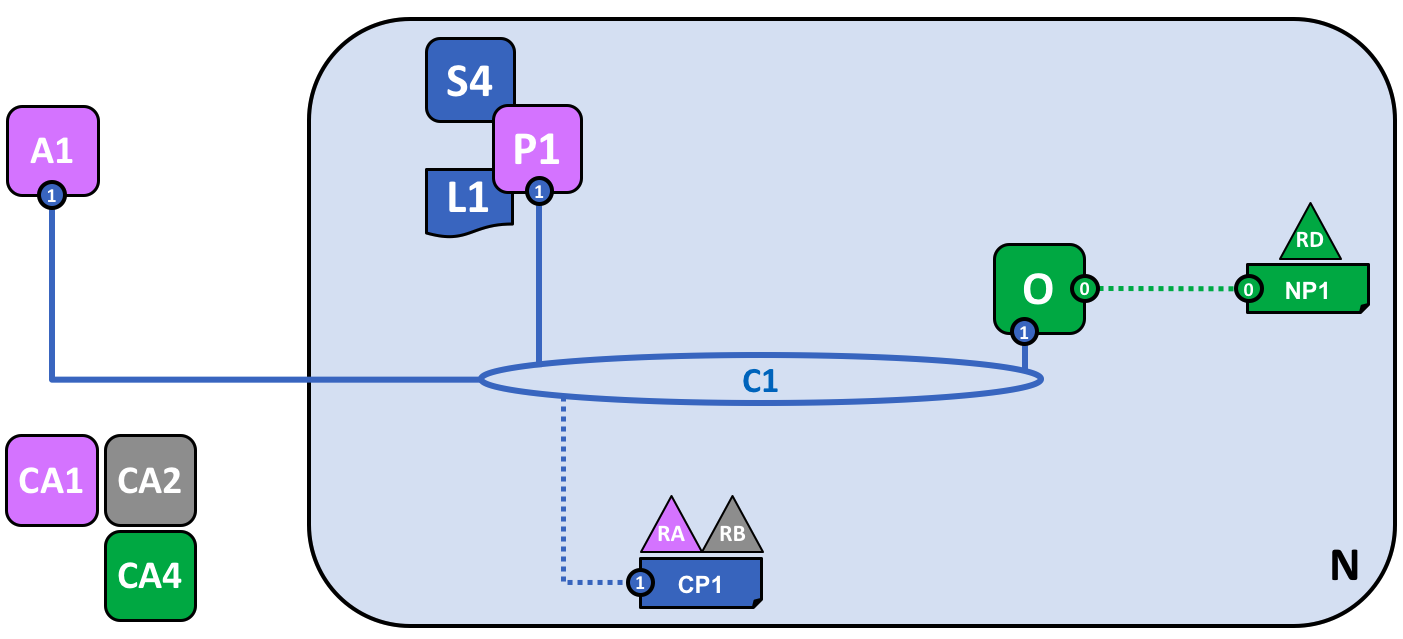 Caption
In the next stage of network development, we can see that A1 has used channel C1 to connect to the network – in this case A1 can connect to both peer node P1 and orderer O1. Again, see how channels are central to the communication between network components. Just like peers and orderers, an application will have an identity that associates it with an organization. In our example A1 is associated with R1.
It might now appear that A1 can access the ledger L1 directly via P1, but in fact, all access is managed via a special program called a smart contract chaincode, S4. Think of S4 as defining all the common access patterns to the ledger, so that there is a well-defined set of ways by which the ledger L1 can be queried or updated. In short, A1 has to go through S4 to get to ledger L1!
Chaincodes are created by application developers to implement a business process shared by the consortium members. Chaincodes take a transaction proposal from an application and operate on a ledger to generate a transaction response. But before an application can invoke a chaincode, two things must happen. Firstly, the chaincode must be installed on a peer. In our example, S4 has been installed on P1 by an administrator in R1.
Secondly, after the chaincode S4 has been installed, it can then be instantiated on the channel C1, so that it can be invoked by any component joined to the channel. In our example S4 is instantiated on C1 – and can now be invoked by A1!
The most important piece of information that is supplied at chaincode instantiation is an endorsement policy. This describes which organizations must approve transaction proposals generated by a chaincode before these transactions will be accepted onto the ledger. The endorsement policy for S4 is stored in the channel configuration CC1, and in our example, transactions can be accepted onto the ledger only if R1 or R2 endorse them. You can read more about endorsement policies in the transaction flow topic
By this stage in network development we can see that organization R1 is fully participating in the network. Its applications – starting with A1 – can access the ledger L1 via smart contract S4, and create transactions that will be endorsed by R1, and therefore accepted onto the ledger because they conform to the endorsement policy.
Growing the network
However, let’s recall that channel C1 was created for consortium X1, so the next stage of network development sees R2 add a similar set of network components to R1.
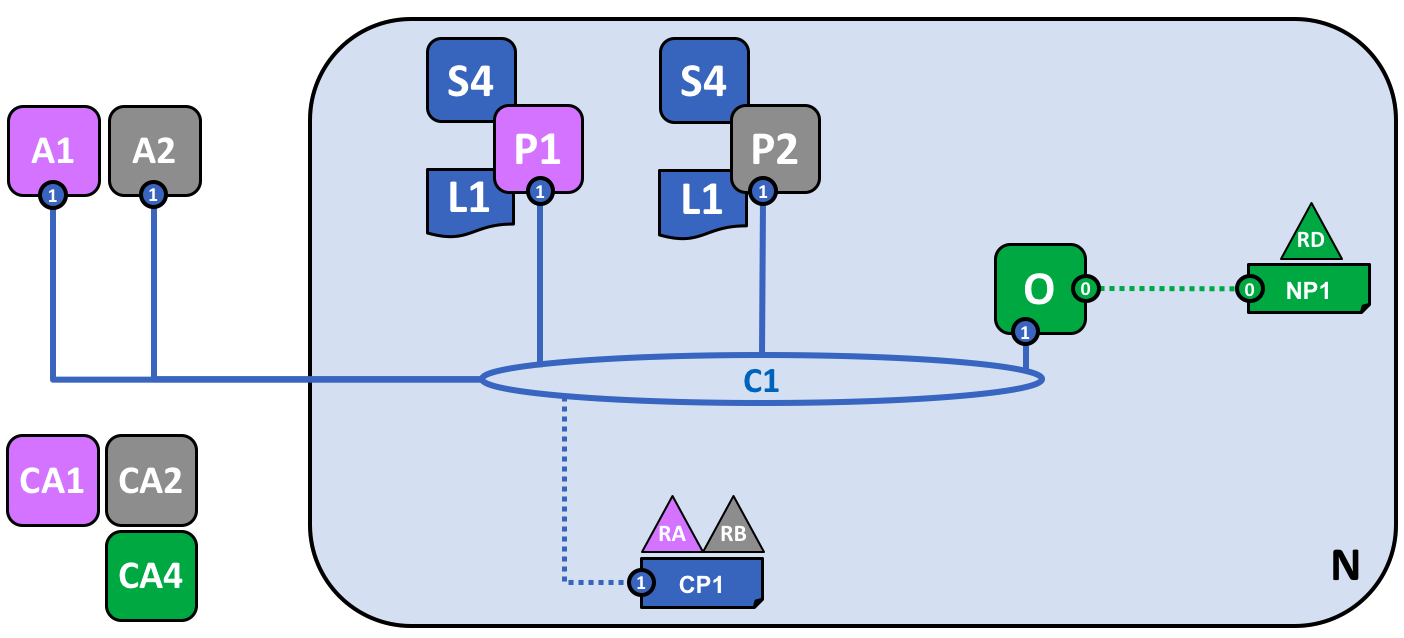 Caption
Specifically, R2 adds a peer P2 on channel C1 which hostsa copy of the ledger L1 and smart contract S4. R2 does not need to instantiate S4 on C1 because everyone on C1 already knows about S4. At this stage of network development R2 is merely adding another instance of of L1 and S4 to the network. Again, see how the ledger L1 really does exist in a physical manner on the peers, and a logical manner on the channel.
At this stage in network development, we have created a channel in which both member organizations, R1 and R2, of consortium X1, can fully participate.
Specifically, this means that applications A1 and A2 can generate properly endorsed transactions which can be accepted by peers onto their copy of the ledger. Applications created well formed transactions by asking the endorsing peers repsonsible for @@
using the smart contract S4 hosted on the peers P1 and P2, and subequently distribute them to all ledgers in the network using the ordering service. In our example, that’s the same set of peers, but in general a network contains many more peers without chaincode than peers with chaincode.
While there no theoretical limit to how big a network can get, as the network grows it is important to consider design choices that will help optimize network throughput, stability, and resilience. Evaluations of network policies and implementation of gossip protocol to accommodate a large number of peer nodes are potential considerations.
Simplifying the visual vocabulary
In the diagram below we see that there are two client applications connected to two peer nodes and an ordering service on one channel. Since there is only one channel, there is only one logical ledger in this example. As in the case of this single channel, P1 and P2 will have identical copies of the ledger (L1) and smart contract – aka chaincode (S4).
Adding another consortium definition
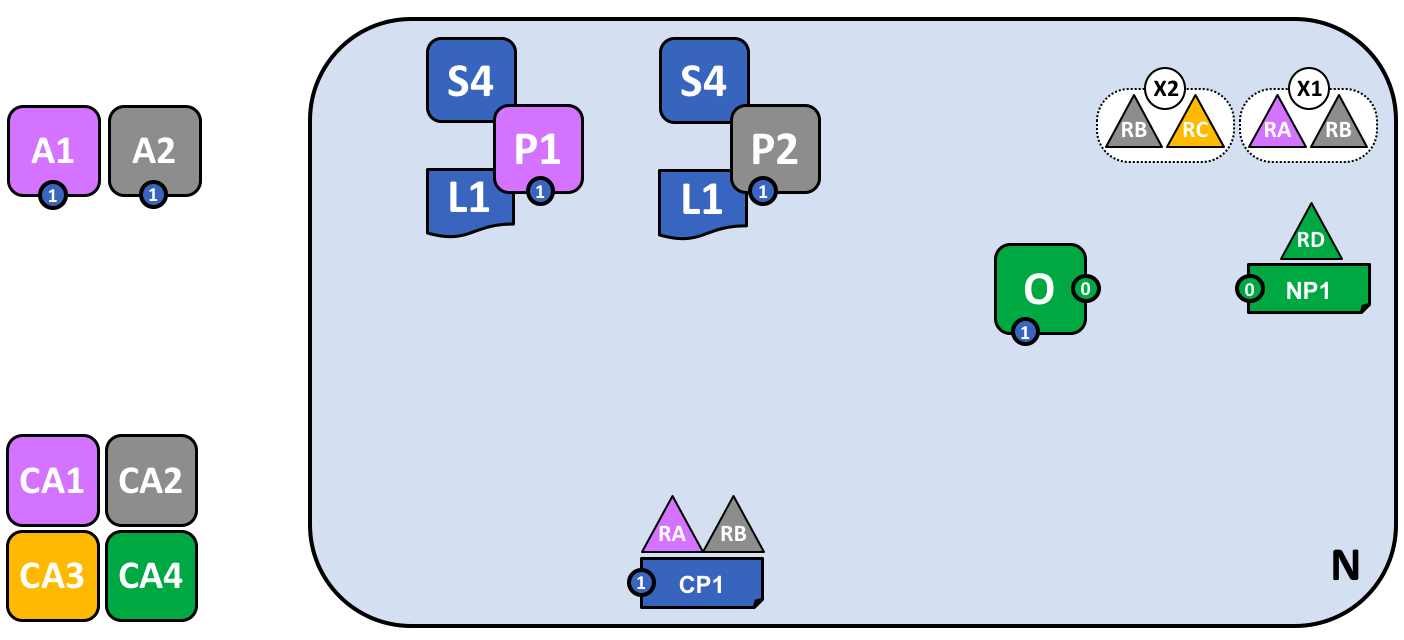
As consortia are defined and added to the existing channel, we must update the channel configuration by sending a channel configuration update transaction to the ordering service. If the transaction is valid, the ordering service will generate a new configuration block. Peers on the network will then have to validate the new channel configuration block generated by the ordering service and update their channel configurations if they validate the new block. It is important to note that the channel configuration update transaction is handled by system chaincode as invoked by the Blockchain network Administrator, and is not invoked by client application transaction proposals.
Adding a new channel
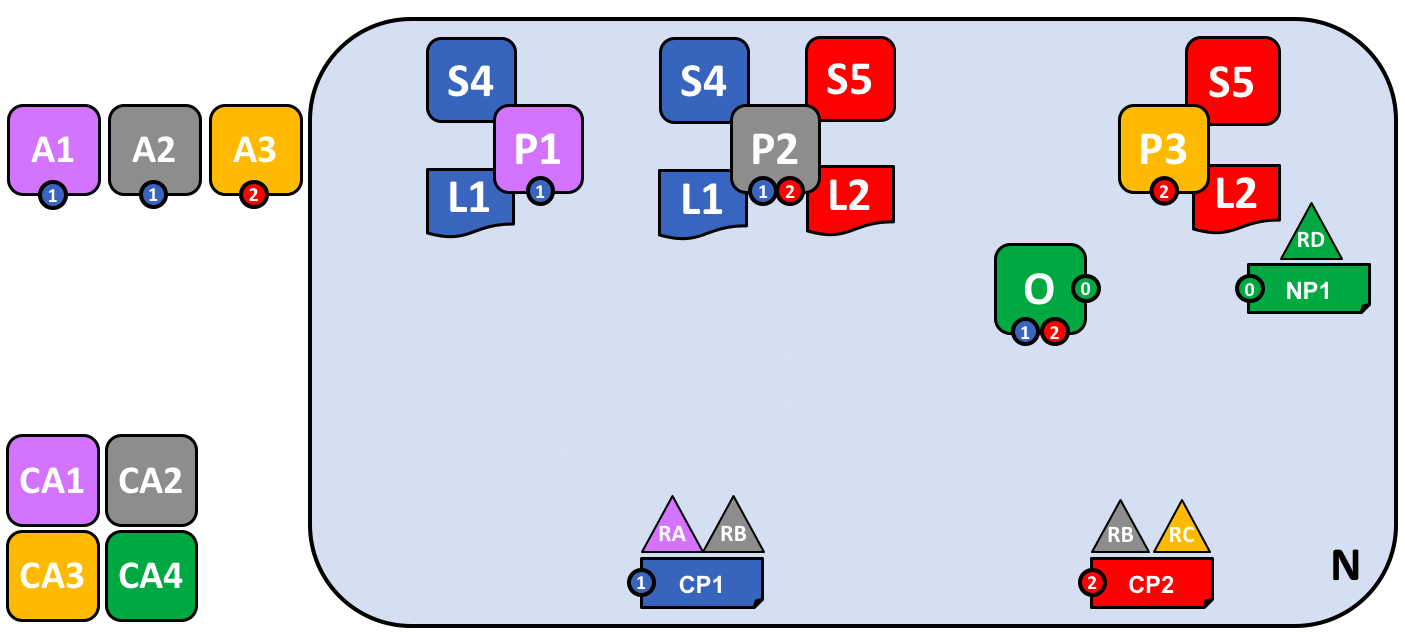
Organizations are what form and join channels, and channel configurations can be amended to add organizations as the network grows. When adding a new channel to the network, channel policies remain separate from other channels configured on the same network.
In this example, the configurations for channel 1 and channel 2 on the ordering service will remain separate from one another.

Adding another peer
In this example, peer 3 (P3) owned by organization 3 has been added to channel 2 (C2). Note that although there can be multiple ordering services on the network, there can also be a single ordering service that governs multiple channels. In this example, the channel policies of C2 are isolated from those of C1. Peer 3 (P3) is also isolated from C1 as it is authenticated only to C2.

Joining a peer to multiple channels
In this example, peer 2 (P2) has been joined to channel 2 (C2). P2 will keep channels C1 and C2 and their associated transactions private and isolated. Additionally, client application A3 will also be isolated from C1. The ordering service maintains network governance and channel isolation by evaluating policies and digital signatures of all nodes configured on all channels.

Network fully formed
In this example, the network has been developed to include multiple client applications, peers, and channels connected to a single ordering service. Peer 2 (P2) is the only peer node connected to channels C1 and C2, which will be kept isolated from each other and their data will remain private. There are now two logical ledgers in this example, one for C1, and one for C2.
Simple vocabulary
Better arrangement
Organization R1 will contribute 3 peers, and 2 client applications of R1 will consume the services of the blockchain network. Organization R2 will contribute 4 peers and has 1 client application. Organization R3 contributes 3 peers and has 2 client applications. Organization R4 contributes 4 orderers. Organization R1 and R2 have decided to form a consortium and exploit a separate application channel between the two of them. Organizations R2 and R3 have decided to form another consortium and also exploit a separate application channel between the two of them. Each application channel has its own policy.
Components of a Network
A network consists of:
- Ledgers (one per channel – comprised of the blockchain and the state database)
- Smart contract(s) (aka chaincode)
- Peer nodes
- Ordering service(s)
- Channel(s)
- Fabric Certificate Authorities
Consumers of Network Services
- Client applications owned by organizations
- Clients of Blockchain network administrators
Network Policies and Identities
The Fabric Certificate Authority (CA) issues the certificates for organizations to authenticate to the network. There can be one or more CAs on the network and organizations can choose to use their own CA. Additionally, client applications owned by organizations in the consortium use certificates to authenticate transaction proposals, and peers use them to endorse proposals and commit transactions to the ledger if they are valid.
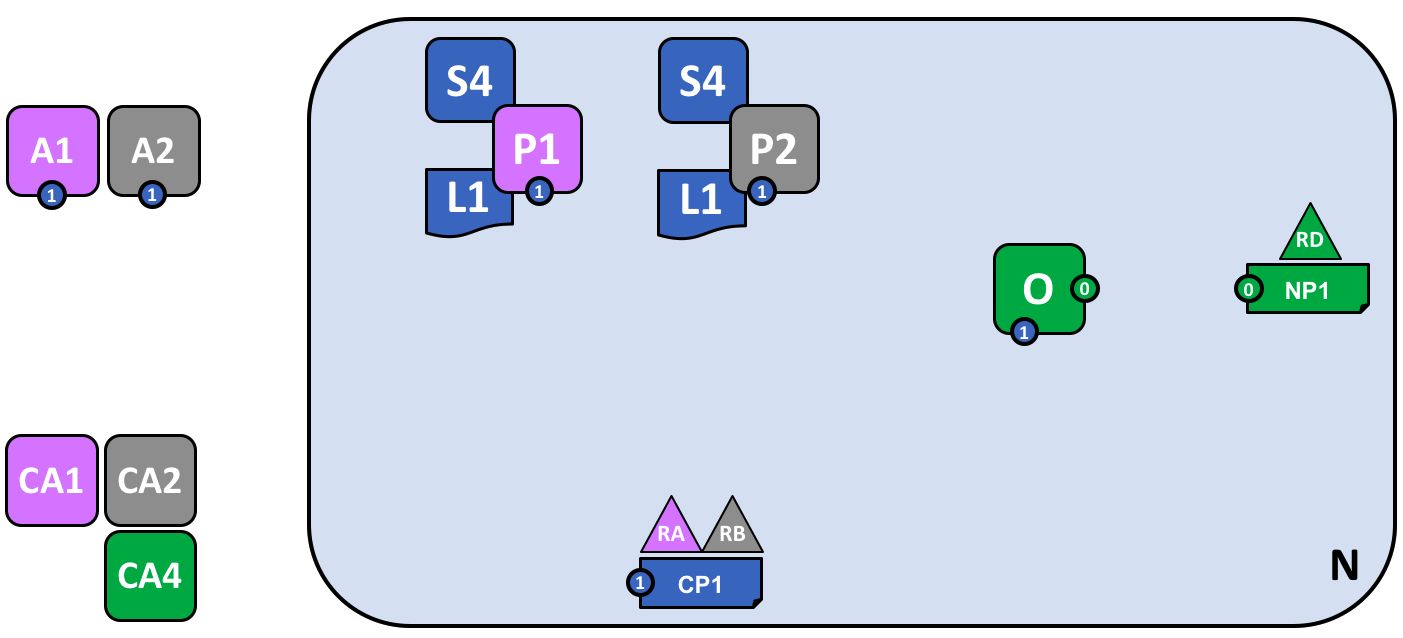
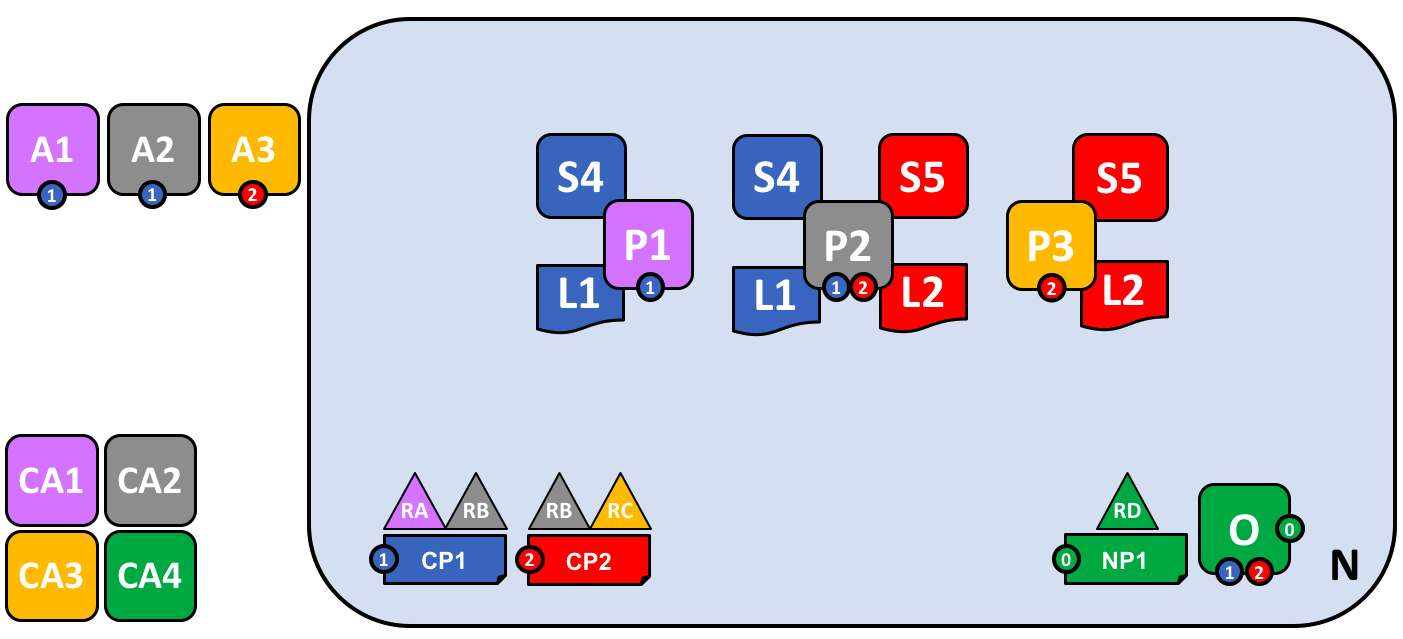
The explanation of the diagram is as follows: There is a Fabric network N with network policy NP1 and ordering service O. Channel C1 is governed by channel policy CP1. Channel C1 has been established by consortium RARB. Channel C1 is managed by ordering service O and peers P1 and P2 and client applications A1 and A2 have been granted permission to transact on C1. Client application A1 is owned by organization RA. Certificate authority CA1 serves organization RA. Peer P2 maintains ledger L1 associated with channel C1 and L2 associated with C2. Peer P2 makes use of chain code S4 and S5. The orderer nodes of ordering service O are owned by organization RD.
This topic document will take you through the decisions that organizations will need to make to configure and deploy a Hyperledger Fabric network, form channels to transact within the network, and how to update those decisions within the life of the network. You will also learn how those decisions are embedded in the architecture and components of Hyperledger Fabric.
which has a policy associated with it that determines the rights of differet
The network is created from the definition of the consortium including its clients, peers, channels, and ordering service(s). The ordering service is the administration point for the network because it contains the configuration for the channel(s) within the network. The configurations for each channel includes the policies for the channel and the membership information (in this example X509 root certificates) for each member of the channel.
Internally, created channels are recorded in a configuration block on the ordering service, which evaluates the validity of the channel configuration. Channels are useful because they allow for data isolation and confidentiality. Transacting organizations must be authenticated to a channel in order to interact with it. Channels are governed by the policies they are configured with.
topic [peers] Peers are joined to channels by the organizations that own them, and there can be multiple peer nodes on channels within the network. Peers can take on multiple roles:
- Endorsing peer – defined by policy as specific nodes that execute smart contract transactions in simulation and return a proposal response (endorsement) to the client application.
- Committing peer – validates blocks of ordered transactions and commits (writes/appends) the blocks to a copy of the ledger it maintains.
Because all peers maintain a copy of the ledger for every channel to which they are joined, all peers are committing peers. However, only peers specified by the endorsement policy of the smart contract can be endorsing peers. A peer may be further defined by the roles below:
- Anchor peer – defined in the channel configuration and is the first peer that will be discovered on the network by other organizations within a channel they are joined to.
- Leading peer – exists on the network to communicate with the ordering service on behalf of an organization that has multiple peers.
Smart contract chaincode must be on a peer, and organizations can choose which
and instantiated on a peer in order for a client application to be able to invoke the smart contract. Client applications are the only place outside the network where transaction proposals are generated. When a transaction is proposed by a client application, the smart contract is invoked on the endorsing peers who simulate the execution of the smart contract against their copy of the ledger and send the proposal response (endorsement) back to the client application. The client application assembles these responses into a transaction and broadcasts it to the ordering service.